Kakuro and Sudoku both use digits 1 through 9, both reward clean logic, and both punish random guessing. That is where the similarity ends. Sudoku is a placement puzzle built around rows, columns, and boxes. Kakuro is a number crossword built around clue sums and no-repeat runs.
If you like Sudoku but want a puzzle with arithmetic pressure, Kakuro is the natural next game. If you dislike arithmetic, Sudoku may feel calmer. This comparison explains the difference so you can choose the right puzzle for your mood.
Short answer: the main difference
Sudoku asks where each digit can go in a fixed 9x9 constraint grid. Kakuro asks which unique digits can add to each clue in a crossword-style run. Sudoku is about coverage: every row, column, and box must contain the digits 1 through 9. Kakuro is about sums: every across and down entry must reach its clue without repeating a digit inside that entry.
| Feature | Kakuro | Sudoku |
|---|---|---|
| Grid shape | Crossword-like grid with black clue cells | Usually a 9x9 grid with 3x3 boxes |
| Main clue type | Sum clues for across and down runs | Given digits already placed in cells |
| Core restriction | No repeated digit inside a run | No repeated digit in row, column, or box |
| Math needed | Addition, subtraction, combinations | Mostly set logic and scanning |
| Best first skill | Recognize forced sum combinations | Scan rows, columns, and boxes |
Rules compared in plain English
In Sudoku, the board tells you some starting digits. Your job is to place the missing digits so that each row, each column, and each 3x3 box contains the digits 1 through 9 exactly once. The given digits are fixed clues.
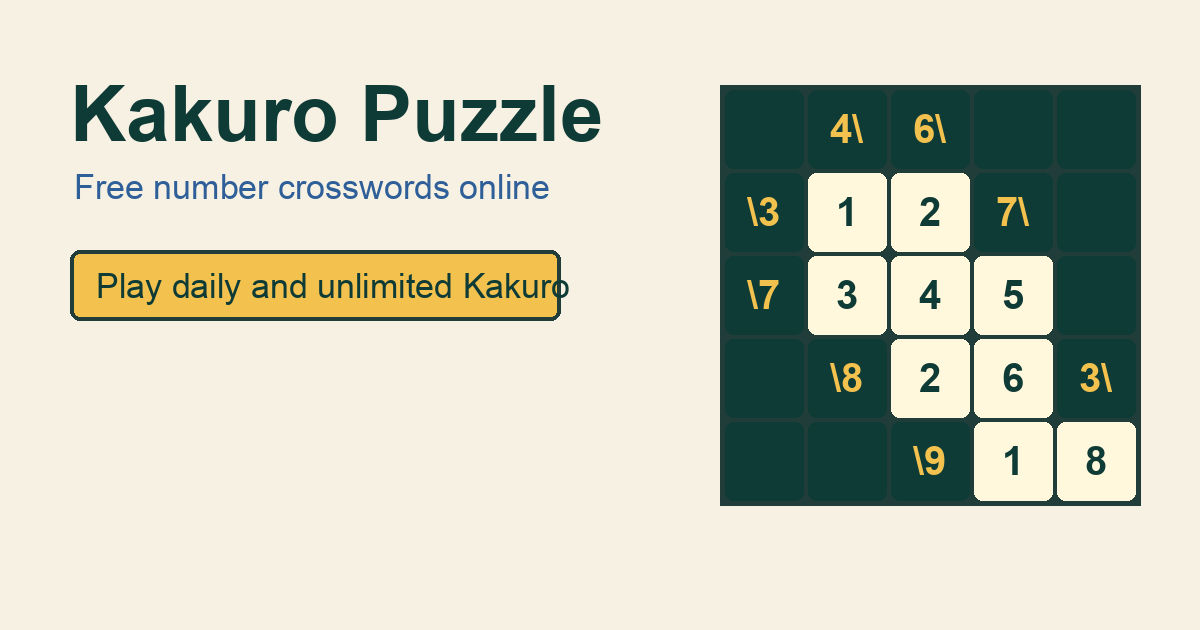
In Kakuro, most clues live in dark cells. A number in a clue cell tells you the total for a connected run of white cells. The cells in that run must contain unique digits from 1 to 9 that add to the clue. The same white cell usually belongs to one across run and one down run, so each placement must satisfy two clues.
That overlap is why Kakuro feels like a crossword. A word in a crossword must fit both its clue and the crossing letters. A Kakuro entry must fit both its sum and the crossing sum constraints.
How the solving logic feels different
Sudoku solving often begins with scanning: which number is missing from this row, which box has only one place for 7, which column blocks a candidate? Kakuro solving begins with arithmetic shape: which digit sets can make this clue, and which crossings can accept those digits?
- In Sudoku, a candidate is usually legal because it does not conflict with a row, column, or box.
- In Kakuro, a candidate is legal only if it belongs to a valid sum combination in both directions.
- In Sudoku, a digit can be forced by one house having one remaining position.
- In Kakuro, a digit can be forced because every legal combination includes it, or because a crossing run leaves only one shared value.
This makes Kakuro more local. One small area can unlock quickly because several short sums intersect. Sudoku often has a broader scanning rhythm across the whole grid.
Which game is harder?
Neither game is automatically harder. Difficulty depends on puzzle construction. Easy Kakuro can be solved with a handful of forced pairs. Hard Sudoku can require advanced chain logic. Hard Kakuro can require careful combination tracking, required digits, and short contradiction checks.
The difference is what kind of difficulty you feel. Sudoku difficulty often feels like pattern recognition. Kakuro difficulty often feels like managing possibilities without losing track of the arithmetic. If you enjoy exact local constraints, Kakuro is rewarding. If you prefer large-grid scanning, Sudoku may feel smoother.
| If you enjoy... | Try... | Reason |
|---|---|---|
| Arithmetic clues | Kakuro | Every placement is tied to a sum |
| Clean visual scanning | Sudoku | The 9x9 structure is stable |
| Crossword-style intersections | Kakuro | Across and down runs cross like entries |
| Symbol-free logic | Sudoku | No addition is required |
| Short tactical breakthroughs | Kakuro | Extreme sums create fast anchors |
Learning curve for Sudoku players
Sudoku players already have two useful habits: they understand candidate elimination, and they know that guessing usually creates a mess. The habit they must change is treating every row or column as one unit. In Kakuro, black cells split rows and columns into separate runs. A digit may repeat in a row if the repeats are in different runs.
The second adjustment is learning combinations. A Sudoku candidate list is often "what digits are absent from this house." A Kakuro candidate list is "what digits can appear in a valid sum set of this length." Once Sudoku players learn that distinction, Kakuro becomes much easier.
Which puzzle should you play today?
Choose Kakuro if you want a puzzle that mixes crossword structure, arithmetic clues, and tight local deductions. Choose Sudoku if you want a familiar 9x9 scan with no addition. Choose both if you want complementary skills: Sudoku trains broad constraint awareness, while Kakuro trains combination reasoning.
If you are new to Kakuro, start with the interactive board at Kakuro Puzzle Online. Use easy or medium boards first. If you are coming from Sudoku, do not rush. Spend a few boards naming runs by clue and length before trying to solve quickly.
Common myths
Myth: Kakuro is only for math people. Kakuro uses arithmetic, but the arithmetic is simple. The real skill is logical elimination.
Myth: Sudoku never uses math. Sudoku uses digits, but not arithmetic sums. Its logic is still mathematical in the broader sense of constraints and proof.
Myth: Kakuro is just harder Sudoku. It is a different puzzle family. Some players find Kakuro easier because short clue sums provide direct anchors.
Myth: Guessing is normal in both games. Well-made Sudoku and Kakuro puzzles are designed to be solved by logic. Guessing usually means you missed a constraint.
FAQ
Is Kakuro more like crossword or Sudoku? Structurally it looks like a crossword because entries cross. Mechanically it shares Sudoku's digit-based logic, but with sum clues added.
Can Sudoku skills transfer to Kakuro? Yes. Candidate elimination, checking intersections, and avoiding guesses all transfer. Combination tables are the new skill.
Which is better for beginners? Sudoku is more familiar, but easy Kakuro is also beginner-friendly once clue cells are explained.
Why do some people call Kakuro Cross Sums? Cross Sums is an older English name. Kakuro became the more common modern name after Japanese puzzle publishers popularized the format.
Sources and further reading
This comparison uses rule explanations from Conceptis Kakuro rules, GMPuzzles, and HowStuffWorks on Kakuro puzzles. For naming and history context, see Conceptis Kakuro history and the general Kakuro overview.