Kakuro is a number crossword: every white cell takes one digit from 1 to 9, and every connected run of white cells must add up to the clue printed beside it. The puzzle feels familiar if you know crosswords, but the solving logic is closer to Sudoku because you place digits by elimination, not by guessing.
This guide is written for someone opening an online Kakuro board for the first time. By the end, you should know how to read the clue cells, how to decide where to start, when to use notes, and how to check a board without turning the puzzle into trial and error.
Quick answer: how Kakuro works
Fill each white square with a digit from 1 to 9. A clue above a vertical run tells you the total for the cells below it. A clue to the left of a horizontal run tells you the total for the cells to its right. Digits cannot repeat inside the same run, so a two-cell clue of 3 must be 1 and 2, while a two-cell clue of 17 must be 8 and 9.
| Board element | What it means | What to do |
|---|---|---|
| White cell | An empty square to fill | Enter one digit from 1 to 9 |
| Across clue | Total for the run to the right | Make the row segment add to that value |
| Down clue | Total for the run below | Make the column segment add to that value |
| Black clue cell | A divider and clue holder | Do not enter a digit there |
| Run | Connected white cells in one direction | Use unique digits that match the sum |
How to read clue cells
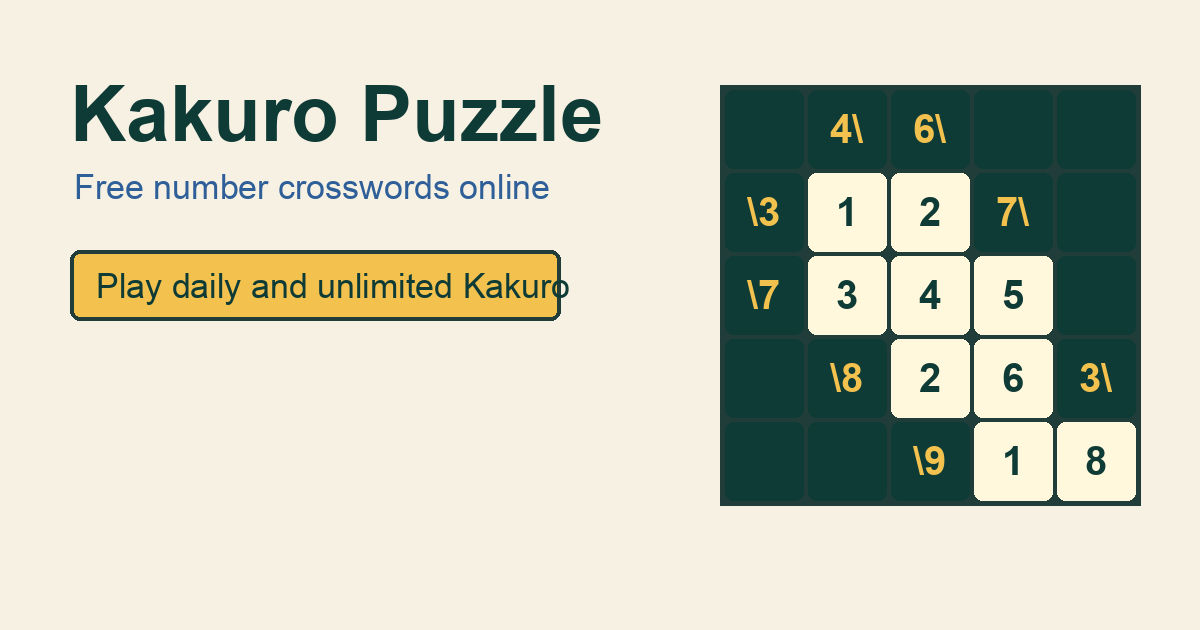
A Kakuro clue cell usually has a diagonal split. The upper-right clue points across; the lower-left clue points down. If a clue cell has only one number, it controls only the run in that direction. If it has two numbers, it starts both an across run and a down run.
The important habit is to name the clue by both its sum and its length. Do not think "this is 16" in isolation. Think "16 in two cells" or "16 in three cells." The length changes everything. A 16-in-two can only be 7 and 9, but a 16-in-three has several possibilities.
On this site, the interactive board also shows across and down clues inside dark cells. Start by clicking a white cell, then read the clue that controls its row and the clue that controls its column. Every real placement must satisfy both at once.
Core rules you must not break
- Use only digits 1 through 9 in white cells.
- Each across run must add exactly to its across clue.
- Each down run must add exactly to its down clue.
- No digit may repeat inside a single run.
- A digit may appear again elsewhere on the board if it is not in the same run.
- A finished board is correct only when every across and down run is simultaneously valid.
The no-repeat rule is where most beginner errors come from. A run with clue 6 in three cells is not any three digits that add to 6; it must be 1, 2, and 3 in some order. You cannot use 2, 2, and 2, even though the sum is correct.
Where to start your first Kakuro board
The best first move is rarely the top-left open cell. Start with short runs and extreme sums because they have fewer combinations. A two-cell clue of 3, 4, 16, or 17 gives you a strong anchor. A three-cell clue of 6 or 24 is also narrow because it sits near the minimum or maximum possible total.
| Clue | Length | Useful fact | Why it helps |
|---|---|---|---|
| 3 | 2 cells | Must use 1 and 2 | Only one pair is possible |
| 4 | 2 cells | Must use 1 and 3 | 2 and 2 is forbidden |
| 17 | 2 cells | Must use 8 and 9 | Only one high pair is possible |
| 6 | 3 cells | Must use 1, 2, and 3 | Minimum three unique digits |
| 24 | 3 cells | Must use 7, 8, and 9 | Maximum three unique digits |
After you find a narrow run, look at each crossing clue. The crossing run often decides the order. If a 3-in-two across run contains digits 1 and 2, and the crossing run allows 1 but not 2, then that shared cell must be 1. If the crossing allows 2 but not 1, it must be 2. If it allows both, wait for another clue before entering a digit.
A safe beginner workflow
- Pick the shortest run with the most extreme clue.
- List its legal combinations, ignoring order at first.
- For each cell in that run, inspect the crossing clue.
- Remove digits that cannot work in the crossing run.
- Enter a digit only when one value survives for a cell or one ordering survives for the run.
- Use notes for candidates, but delete notes as soon as a crossing clue rules them out.
- Run a check only after a logical step, not after every guess.
This workflow keeps you honest. You are not trying to prove that a digit is plausible; you are trying to prove that every other digit fails. That difference is what makes Kakuro satisfying instead of random.
Example: solving a forced crossing
Imagine an across clue of 3 in two cells. Because repeated digits are forbidden, that across run must contain 1 and 2. The first cell crosses a down clue of 4 in two cells, which must contain 1 and 3. The shared cell can only be 1, because 1 is the only digit that appears in both legal pairs.
Once you place 1 in the shared cell, the other across cell must be 2 and the other down cell must be 3. This is the core Kakuro rhythm: identify a narrow sum, compare it with the crossing sum, place only the digit that survives both directions, then update the neighboring run immediately.
Common beginner mistakes
The first mistake is treating Kakuro like normal arithmetic. Sums matter, but the no-repeat rule matters just as much. A second mistake is filling a run before checking crossings. A run can be locally correct and globally wrong. The third mistake is keeping too many notes. Candidate notes are useful only when they shrink. If every cell has five notes forever, you are not solving; you are postponing the solve.
Another common problem is confusing "same board" with "same run." A digit can repeat across the board. It can even repeat in the same row if a black cell splits the row into different runs. The restriction applies inside one continuous clue entry.
How to use the online board well
Use the board at Kakuro Puzzle Online as a practice surface, not just a final answer checker. Start in regular mode if you want a level path, daily mode if you want a dated pack, and unlimited mode if you want repeatable practice by seed.
For new players, notes mode is more useful than hints. A hint can move the board forward, but notes teach the logic. Use hints only after you can explain why the obvious runs are exhausted. Reset is for a corrupted board; undo is for a single bad input.
FAQ
Is Kakuro just Sudoku with addition? No. Both use digits and logic, but Sudoku is about rows, columns, and boxes. Kakuro is about clue sums and crossword-style runs.
Can a digit repeat in a Kakuro row? Yes, if the row is split into different runs. A digit cannot repeat inside one continuous run controlled by one clue.
Do I need advanced math? No. You need addition, subtraction, and combination thinking. The hard part is eliminating possibilities cleanly.
What is the fastest way to improve? Memorize narrow combinations such as 3-in-two, 4-in-two, 17-in-two, 6-in-three, and 24-in-three, then practice using crossings to order them.
Sources and further reading
This guide was cross-checked against Conceptis Kakuro rules, GMPuzzles Kakuro rules and info, and the Penny Dell Cross Sums/Kakuro solving guide. For background on why Kakuro feels like a number crossword, see HowStuffWorks on Kakuro puzzles.